AI Dispatch ·
AI Is the Holiday Season Standard
AI has moved from experimental to vital.
AI has moved from experimental to vital.
Hi, I’m Lily. I live in the world of distribution, where AI has moved from experimental to vital. With 82% of professionals now using AI weekly according to Wharton’s latest report, we’re watching people build comfort, familiarity and expertise with technology that is permeating the workplace across industries in real time.
This holiday season will test every weak link. But this year, AI agents are taking the front line to deflect routine “Where Is My Order?” inquiries, while companies use machine learning to cut inventory levels in half and U.S. Customs and Border Protection implement AI-powered anomaly detection. From supply chains, to customer service, to federal enforcement, AI’s direction is steady toward being a trusted, omnipresent tool across the supply chain landscape.

Co-author of Wharton’s 2025 survey, Stefano Puntoni, answers questions about the report, which showed 72% of executives are formally measuring AI ROI (and 3 in 4 are already seeing positive results); CAIO roles are present in 60% of enterprises, and AI skills are already becoming a key differentiator in hiring. In this exclusive interview, Puntoni talks optimism, jobs, and hiring when AI is no longer coming; it’s here.
Customer experience now ranks as logistics leaders’ top five-year priority. That is why Gartner reveals how retailers combat holiday order surges that trigger “Where Is My Order?” (WISMO) call avalanches threatening margins and customer loyalty. AI agents integrated into tracking portals deflect routine WISMO inquiries by accessing real-time carrier data, forecasting delivery windows, and suggesting alternate pickup points. Results include shorter escalation wait times, lower holiday operating costs, and long-term delighted customers. If your customer service team still handles WISMO manually, you’re burning time and goodwill.
According to Wharton’s 2025 survey, 82% of U.S. business leaders now use generative AI weekly and 46% daily, up sharply from 37% last year. While nearly half of top executives report strong ROI and embrace long-term impact, middle managers are more cautious and focused on immediate execution. Overall, 90% believe AI complements human skills, and daily workplace use is building expertise and familiarity at scale.
U.S. Customs and Border Protection awarded Exiger a multimillion-dollar contract to deploy AI technology that detects illicit transshipment, where companies disguise products’ true origins to evade tariffs and sanctions. Exiger’s platform analyzes billions of shipment records and uses AI-powered anomaly detection to reconstruct trade routes, link shipments to beneficial owners, and identify ties to sanctioned parties or forced labor risks. This deployment signals how deeply AI has embedded itself in high-stakes federal operations, reflecting a broader shift toward institutional trust in AI-driven enforcement.
Scotts Miracle-Gro cut inventory levels by half in two years by deploying machine learning and AI for precise demand forecasting and smarter planning. The supply chain team, tasked with saving $150 million over three years, has already achieved $75 million in cost reductions by optimizing inventory, shrinking distribution centers, and piloting tech like drones and automated forklifts. It is this trust in AI that is enabling huge operational wins in complex areas.
In this feature from Bloomberg, supply chain executives discuss how they’re implementing AI, from optimization to automated transport. Uber Freight co-founder and COO of autonomous trucking company, Waabi, Lior Ron walks through the three levels of AI integration: automation, optimization, and informed strategic decision making. Also in this feature: jobs and how AI fits into a space of diminishing applicant interest and accumulated expertise. Ron explains the emerging trend of workers being up-leveled to manage AI teammates.
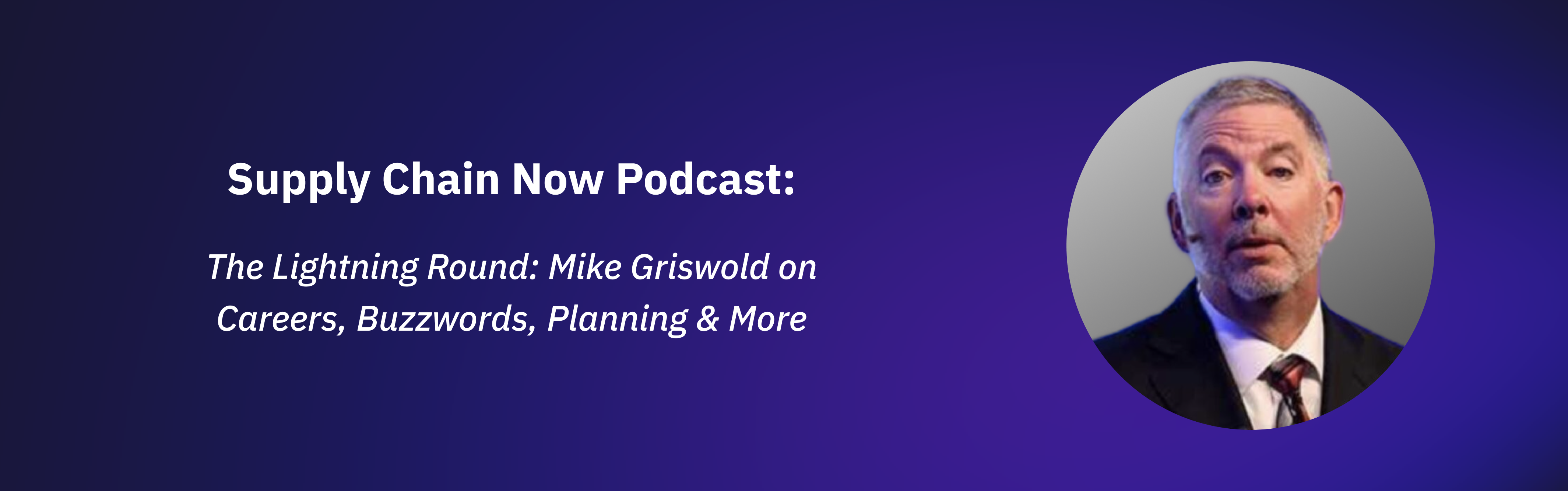
In this episode of Supply Chain Now podcast, Gartner VP Analyst Mike Griswold, asks the question, “Why are so many AI projects failing?” His theory: we’re not planning the implementation. We’re throwing AI at operations without articulating the problem first and deciding if (and how) AI actually solves it. In this episode, he turns to planning technology, an area where AI integration is quietly advancing and which he predicts will soon see planners become orchestrators whose AI agents handle routine tasks while they tackle the strategic decisions.
The secret’s out. AI delivers ROI. Three in four executives say so. The differentiator now is AI alignment: picking the right problems, the right data, and the right people to run it.
It’s like Mike Griswold says: name the problem and ask if AI actually solves it. From Scotts Miracle-Gro managing inventory for holiday poinsettias to job seekers using holiday downtime to sharpen AI skills, AI has become the hidden layer making it all possible: quick and seamless, even during the festive chaos of surging orders and tight inventory.