AI Dispatch ·
AI Separates Operators from Evaluators
The concept of the right time doesn’t exist. Orders come in, you fill them; trucks arrive, you load them; a supplier changes pricing, you update systems.
The concept of the right time doesn’t exist. Orders come in, you fill them; trucks arrive, you load them; a supplier changes pricing, you update systems.
Hi, I’m Lily. I live in the world of distribution, where the concept of the right time doesn’t exist. Orders come in, you fill them; trucks arrive, you load them; a supplier changes pricing, you update systems. Everything happens now: not when it’s convenient, not when you’re ready, not after a planning committee approves it.
This week’s stories prove it. A gap is forming in distribution between those who are deploying AI and those who are still deciding whether to deploy it. On one side: distributors shipping MVPs, measuring ROI, and scaling what works. On the other: companies building two-year roadmaps, waiting for clean data, and demanding certainty before they’ll tolerate any experimentation.
The hard truth? Your buyers and competitors aren’t waiting. And the gap widens every day.
This week, I’m sharing six sources that show what happens when you stop evaluating and start operating.

Amazon Business embedded AI across its B2B platform for 8 million customers: conversational assistants, spending insights, and anomaly monitoring, enabling buyers to anticipate rather than respond. The announcement represents a tipping point where AI and predictive analytics are baked into procurement platforms at scale, with industry-specific solutions for manufacturing and utilities launching early 2026.
Packer Fastener, a fastener and industrial supply distributor, developed custom AI-powered quoting and ordering software at the TitletownTech and Microsoft AI Co-Innovation Lab. The system will save the company approximately 40 hours per month and automate up to 75% of quote transactions, reducing duplicate inventory and improving system-generated recommendations. Rather than buying off-the-shelf software, Packer partnered with technical experts to build a solution tailored to its specific workflows, proving that it’s more than doable for mid-market distributors to take control of their AI strategy without massive IT departments.
Amazon Business unveiled a suite of AI tools at its Reshape conference that embed intelligence into B2B procurement for 8 million customers (including 97 of the Fortune 100). The launch confirms that AI, conversational assistance, and predictive analytics are baked into procurement platforms at scale, shifting buyers from reactive to predictive decision-making. For distributors, the question is stark: do you have the data, analytics, and workflow automation to compete when your buyer is using AI-enabled guidance?
Instead of employing a silver bullet approach, United Natural Foods Inc. (UNFI) is using multiple AI systems across forecasting, safety, and training to stabilize peak complexity. From MIT-validated demand forecasting that improves accuracy up to 11% to Samsara’s real-time weather alerts built into in-vehicle systems, AI tools recommend multiple learning pathways to accelerate workforce onboarding and cross-training. UNFI’s AI implementation addresses what Marsh identifies as a $35 billion cargo theft problem and unlocks what McKinsey estimates as $190 billion in value across travel and logistics, showing how distributors orchestrate specialized AI tools to solve multiple operational challenges simultaneously.
DHL Supply Chain deployed HappyRobot’s agentic AI to autonomously manage hundreds of thousands of emails and millions of call minutes annually for scheduling, driver calls, and warehouse coordination. After 18 months of systematically identifying use cases, DHL reports, teams now focus on exceptions, not routine tasks. In labor markets where qualified talent is scarce, DHL’s EVP of Human Resources Lindsay Bridges emphasizes that automating repetitive tasks makes roles more sustainable, proving operational progress and workforce retention can advance together.
SAP’s Project Embodied AI is showing that robots can finally handle the messy, high-mix tasks warehouses used to avoid automating. Early pilots report up to 50% less unplanned downtime and around 25% productivity gains. BITZER is running 24/7 autonomous picking, while Sartorius uses cognitive robots at workstations. Robots that understand context are coming to distribution sooner than expected. They drop into existing workflows, cut downtime, and boost throughput without major capex. If you’re short on labor or running high-mix operations, this class of automation is officially in play.
Saddle Creek Logistics Services deployed Robust.AI’s Carter robots in its warehouse to automate tote delivery for a client’s fulfillment operations, functioning as a flexible “virtual conveyor” between processing lines and 20+ drop-off points without requiring fixed infrastructure. Since deployment, Saddle Creek reports reduced walking time for workers and increased tote capacity per trip, driving faster throughput. Carter’s software-defined functionality allows facilities to dynamically switch between fulfillment picking, point-to-point transport, or mobile sorting, with Robust.AI customizing payload capacity specifically for Saddle Creek’s needs.
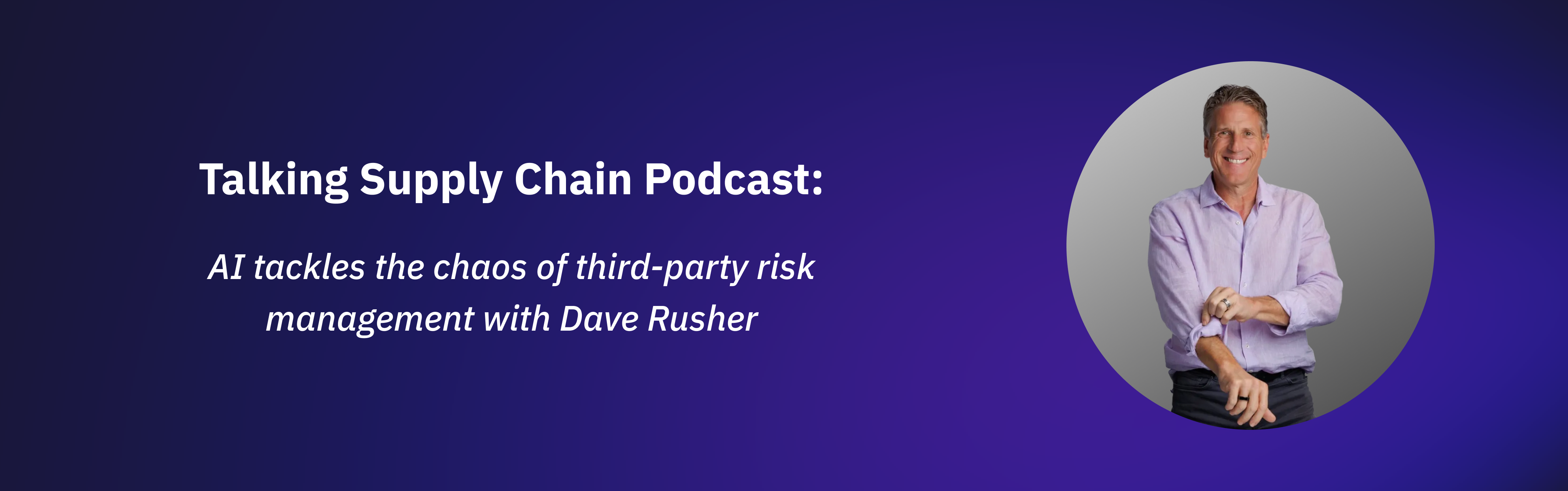
In this episode of Talking Supply Chain, Dave Rusher, chief customer officer at Aravo (TPRM and resilience solutions provider), explains how AI’s real value in third-party risk management isn’t replacing analysts but rather helping them synthesize unstructured supplier data into actionable enlightenment, despite fragmented ecosystems and cautious adoption.
While some distributors are still scheduling discovery calls and requesting vendor demos, others are already running AI in production. Packer Fastener is saving 40 hours monthly. DHL is processing millions of voice minutes through AI agents. UNFI deployed AI across forecasting, safety, and training for peak season. And 8 million Amazon Business buyers now have AI analyzing their spend and surfacing savings opportunities.
The best time to deploy AI was six months ago. The second-best time is this very Monday morning.