Private Equity Edition ·
AI Pulls PE Off Defense
For the past two years, the dominant PE conversation around AI has been about protection: which portfolio companies are exposed, which business models are…
For the past two years, the dominant PE conversation around AI has been about protection: which portfolio companies are exposed, which business models are…
Hi, I’m Lily. I created this PE edition of the AI Dispatch for our growing community of thousands of private equity leaders and portfolio company operators navigating AI implementation.
This week’s theme: The Defensive Window Is Closing.
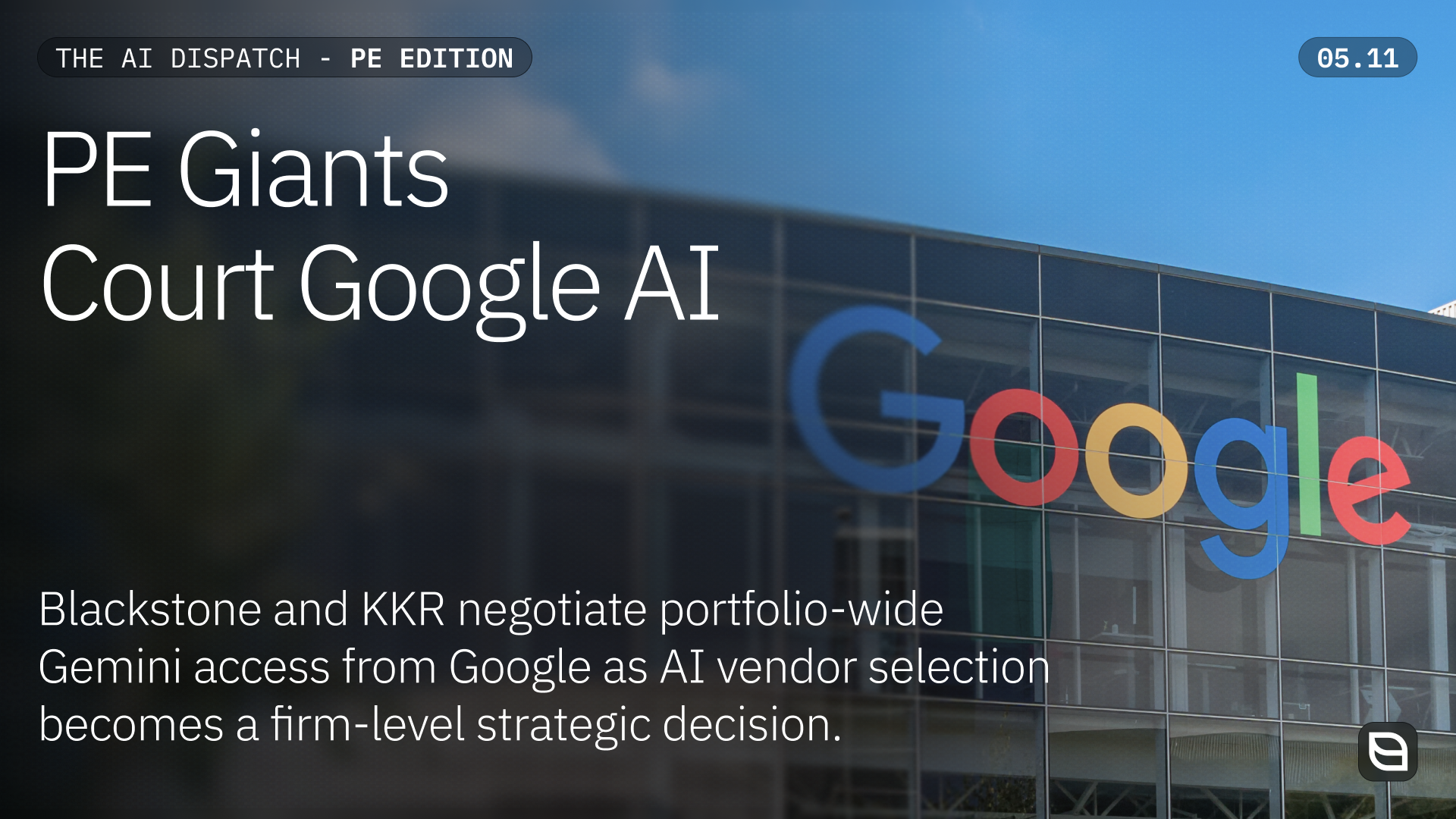
For the past two years, the dominant PE conversation around AI has been about protection: which portfolio companies are exposed, which business models are at risk, which software holdings need to be stress-tested against disruption. That posture made sense. But this week, the largest names in the industry are signaling it has a shelf life. TPG's Jim Coulter is calling a nine-month window before the industry pivots from defense to offense. Blackstone is restructuring its entire growth platform around AI as a standalone institution. And EY's data shows capital already moving away from legacy software and toward AI-native tools that drive measurable operational performance. The firms and operators who spent the last two years getting ready are about to have a significant advantage over those who spent it waiting.
EY's Q1 2026 Private Equity Pulse captures a market that entered the year with momentum but quickly recalibrated. The report covers four main areas: deal activity, AI's impact on software investment, sector rotation, and exits. The most significant shift is AI-driven: tech's share of global PE deployment fell from 30% to 12% in a single quarter as GPs intensify scrutiny on legacy software models vulnerable to AI displacement. Capital is rotating: away from traditional SaaS and toward AI-native solutions that drive measurable operational performance. 60% of GPs report increased AI disruption diligence on deals. Returns are now built on operational value creation vs multiple expansion, and the tools winning inside portfolio companies are the ones that work within existing systems, not beside them. Read more →
Blackstone is moving AI from investment theme to institutional infrastructure, creating Blackstone N1, a dedicated West Coast division centralizing all AI and high-growth tech bets. Led by Jas Khaira out of San Francisco, N1 will coordinate AI investing across Blackstone's private equity, growth capital, and opportunistic platforms, with exposure spanning data centers, digital infrastructure, and energy assets supporting AI compute. The move follows Blackstone's playbook of consolidating high-conviction strategies into dedicated units, the same approach previously applied to credit and insurance. Read more →
TPG is drawing a line between PE firms that are managing AI defensively and those ready to use it as a growth weapon, and it's planting its flag firmly on the offensive side. On its Q1 earnings call, founding partner Jim Coulter predicted a PE-wide shift toward offensive AI strategy within nine months, calling it the most powerful value creation tool the industry has seen in years. The numbers back the posture: TPG's software portfolio companies posted 20% YoY bookings growth in Q1, only 7% of Fund VIII's remaining $13.7B in value carries material AI risk, and Fund X was underwritten with AI positioning as a central criterion from day one. For operating partners still in reactive mode, TPG's call is a signal: the window for playing defense is closing. Read more →
Every week, we’ll bring you a new, real-world example of how targeted AI deployments within portfolios are solving persistent business challenges.
Company: Partner in Pet Food (CVC Capital Partners | Cinven portfolio company), Europe’s largest private-label pet food manufacturer.
Problem: PPF had extracted everything its planning platform could offer. After years of tuning and consulting investment, capacity utilization had stalled, planners were consumed by manual rework, and further efficiency gains had become structurally impossible. The system wasn’t failing, it had simply reached its ceiling. A rip-and-replace was not an option.
Solution: PPF layered an agentic AI solver engine directly on top of its existing environment. The deployment introduced probabilistic, multi-pass scenario solving, real-time production intelligence, and automated planning-by-exception workflows, breaking through the performance ceiling without dismantling the core infrastructure. The first plant went live in six weeks.
Results:
13% increase in capacity utilization - new output unlocked without capital expenditure
$8M in projected annual savings from waste reduction and improved production alignment
Dramatically reduced manual planning steps, freeing planners to focus on higher-value decisions
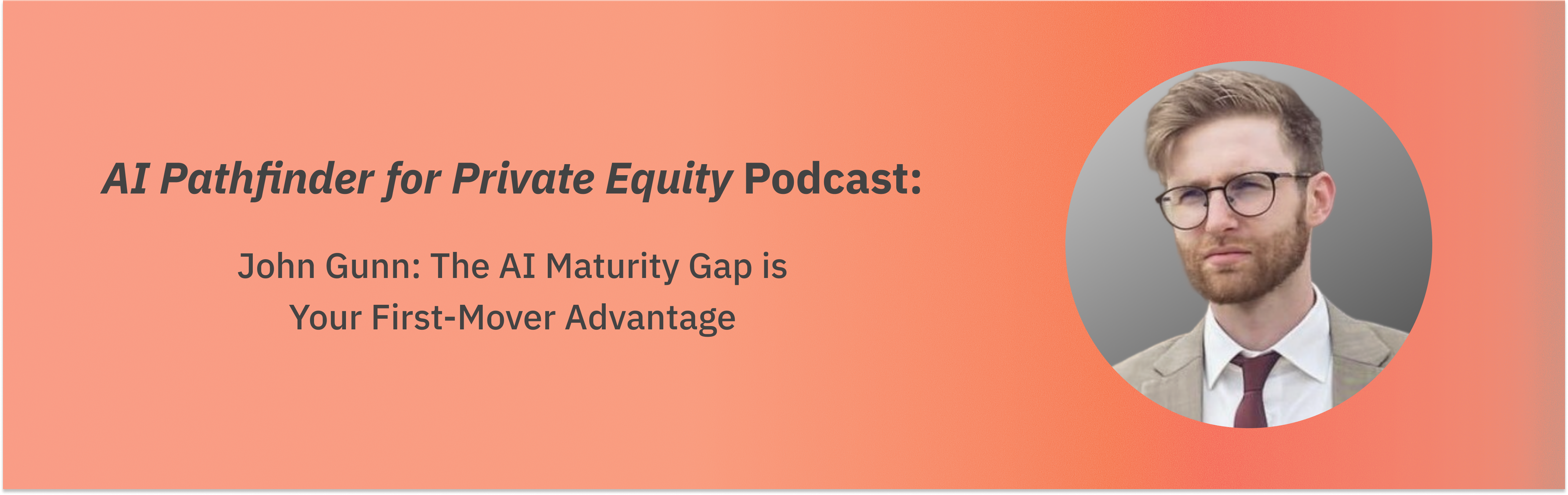
In this episode of AI Pathfinder for Private Equity, John Gunn, Lead Data Science and AI at IK Partners, breaks down what it actually looks like to build an AI operator role from the ground up, working across 30 - 40 portfolio companies simultaneously. He introduces a practitioner framework for formalizing workflows through agents by turning operational knowledge into transferable IP that survives platform transitions, and flags second-order data relationships in due diligence as a massively underexplored source of signal. For operating partners managing multiple portcos, this episode is a blueprint for scaling AI impact without scaling headcount. Listen here →
PPF's story is the operational proof of everything the GPs are signaling from the top. You don't need a new system, a new fund structure, or a nine-figure AI budget to start playing offense. Instead, you need a clear problem, the right tool layered on what you already have, and the willingness to move before the window closes. The maturity gap John Gunn describes is real, and it is compounding every quarter. The firms and portcos pulling ahead aren't doing something fundamentally different. They're just doing it now.